
MAMA-SYNTH 2026
Synthesizing Virtual Contrast-Enhancement in Breast MRI
MAMA-SYNTH is a challenge focused on synthesizing virtual post-contrast breast MRI from pre-contrast T1-weighted MRI. The benchmark is designed to support the development of clinically meaningful contrast-reduced and contrast-free breast MRI workflows.
🔗 Official website: MAMA-SYNTH Challenge
🗂 Proposal: Zenodo
💻Preprocessing & Evaluation Code: github.com/mama-research/mama-synth/
📗 Camera Ready Instructions: Checklist
Dynamic contrast-enhanced MRI (DCE-MRI) plays a central role in breast cancer diagnosis, treatment planning, and disease monitoring. However, the use of gadolinium-based contrast agents introduces important concerns related to patient safety, environmental contamination, and accessibility of advanced imaging workflows. MAMA-SYNTH provides a standardized evaluation framework for generative models that aim to recover diagnostically relevant post-contrast information from non-contrast acquisitions.
This challenge is intended to support fair and open comparison of synthesis methods across institutions, imaging settings, and downstream clinical objectives.
🎯 Challenge Objective
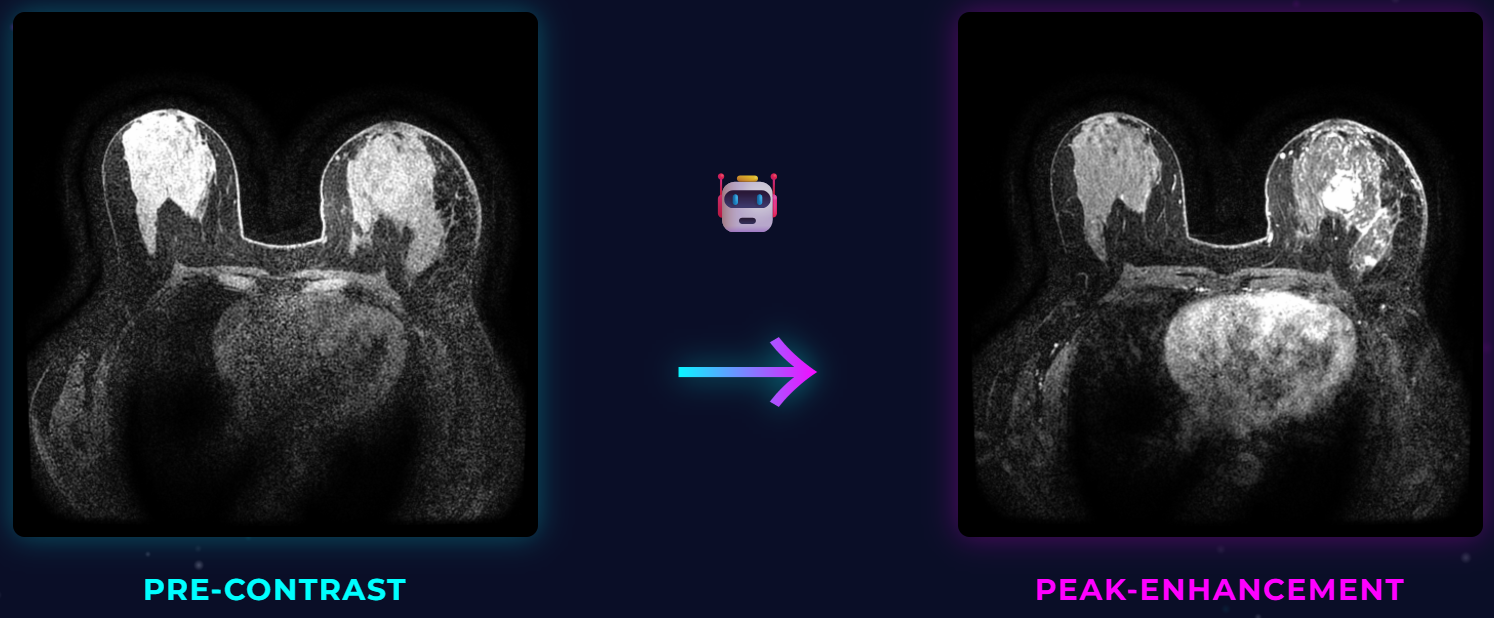
Participants are asked to generate single-timepoint 2D peak-enhancement post-contrast breast DCE-MRI slices from corresponding pre-contrast T1-weighted MRI inputs.
More specifically, each submitted method should take a pre-contrast breast MRI slice as input and produce a synthetic post-contrast image corresponding to the peak-enhancement phase. The challenge is designed not only to assess image similarity, but also to evaluate whether synthesized images preserve clinically meaningful tumor information.
💡 Why This Challenge Matters
The motivation for MAMA-SYNTH is both clinical and practical.
- Clinical relevance: Contrast-enhanced breast MRI is highly valuable for lesion visualization, diagnosis, and treatment planning.
- Safety motivation: Repeated exposure to gadolinium-based contrast agents remains a concern, particularly in patients requiring longitudinal imaging and pre-existing conditions.
- Environmental motivation: Gadolinium contamination has been detected in water systems, raising broader concerns beyond clinical use alone.
- Accessibility motivation: Contrast-enhanced MRI increases scan complexity, cost, and resource requirements, which may limit access in some settings.
By enabling rigorous comparison of virtual contrast-enhancement methods, MAMA-SYNTH aims to support the development of imaging workflows that are safer, more scalable, and more widely accessible.
Data Summary
A multi-center benchmark is provided to evaluate the robustness and generalizability of synthesis methods.
- Training cohort: MAMA-MIA dataset, including 1,506 patients from 25+ centers in the United States
- External test cohorts:
- Radboud University Medical Centre, The Netherlands — 200 cases
- Instituto Alexander Fleming, Argentina — 100 cases
The challenge uses external institutional test cohorts to promote fair evaluation across scanners, protocols, and patient populations.
Evaluation Summary
Submissions are assessed across four complementary dimensions:
- Image-to-image fidelity
- ROI-to-ROI tumor realism
- Downstream classification performance
- Downstream segmentation performance
This evaluation design aims to reward methods that are not only visually plausible, but also clinically useful.
Challenge Phases
The challenge is organized into multiple phases to support method development, validation, and final testing.
- Validation phase: participants can test and refine their methods under the official submission framewor using 50 representative cases.
- Test phase: final submissions are evaluated on the hidden test data consisting 300 cases and used for the official ranking.
📅 Important Dates
- May 8, 2026 — Validation phase opens
- June 25, 2026 — Test phase opens
- July 10, 2026 — Last submission deadline
- July 15, 2026 — Paper Submission Deadline
July 31, 2026 — Paper Review Results OutAugust 1August 2, 2026 — Paper Review Results Out/Official results releaseAugust 8August 16, 2026 — Camera Ready Deadline- September 27, 2026 — Winners announcement at the Deep-Breath Workshop (MICCAI 2026)
🚀 Participation
Participants should submit their methods through the Grand Challenge platform.
Teams may use the provided challenge data and additional publicly available datasets, subject to the challenge rules. The use of private datasets is not allowed.
We envision that MAMA-SYNTH will enable a fair and clinically meaningful comparison of virtual contrast-enhancement methods for breast MRI, and help advance research toward safer and more accessible imaging workflows.
📬 Contact
For inquiries, please contact:
- Smriti Joshi — smriti.joshi@ub.edu
- Richard Osuala — richard.osuala@gmail.com
- Jarek van Dijk — jarek.vandijk@radboudumc.nl